

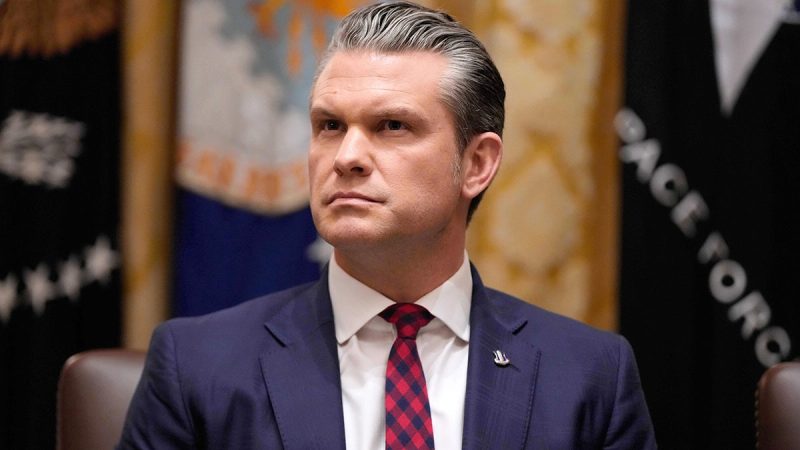
War Secretary Pete Hegseth said Tuesday that Russia ‘should not be involved’ in the escalating conflict between the United States, Israel and Iran, even as analysts point to Russian military activity that aligns with reports Moscow may be aiding Tehran.

‘The president maintains strong relationships with world leaders, which creates opportunities and options for us in very dynamic ways,’ Hegseth said when asked about President Donald Trump’s recent call with Russian President Vladimir Putin.
But as it relates to the Middle East conflict, he added, Russia ‘should not be involved.’
The administration’s messaging comes amid reports that Russia has provided information that could help Iran identify U.S. military assets in the Middle East. Moscow has not publicly confirmed the claims.
Intelligence assessments have reportedly said Russia provided Iran with information that could help identify the locations of American warships, aircraft and other military assets. Officials reportedly stressed there is no public evidence that Moscow is directing Iranian strikes, but said the information could assist Tehran’s targeting efforts.
The scope, timing and operational impact of that information have not been publicly detailed.
While there is no public evidence definitively proving Russia is providing real-time targeting data, George Barros, a Russia expert at the Institute for the Study of War, said open-source indicators are consistent with the type of support described in the reports.
Barros pointed to Russian military reconnaissance satellites, including Cosmos-2550, a radar and electronic signature spacecraft that recently passed over the Persian Gulf and Arabian Sea — areas where U.S. forces have been operating.
‘They’re specialized for naval reconnaissance and detecting ships, because the radar signature off the water really pings it quite well,’ Barros said. ‘These are known capabilities of the Russians.’
Such radar systems can detect maritime targets and electronic emissions that reveal force positioning. Barros said those capabilities align with known gaps in Iran’s own space-based intelligence collection.
Although he cautioned that he does not have dispositive proof of real-time targeting support, Barros said the convergence of Russian reconnaissance capabilities, satellite positioning and reported cooperation ‘makes total sense.’
Trump on Monday described his recent conversation with Putin as ‘very good’ and ‘constructive,’ saying the Russian leader ‘wants to be very constructive.’ Trump suggested Moscow could be more helpful by helping bring the war in Ukraine to an end.
Iran’s foreign minister, Abbas Araghchi, acknowledged over the weekend that Russia is assisting Iran ‘in many different directions’ in its war with the United States and Israel. Pressed on whether that includes intelligence sharing, Araghchi said, ‘They are helping us in many different directions,’ but added, ‘I don’t have any detailed information.’
Beyond intelligence collection, analysts say battlefield patterns suggest tactical cross-pollination between Russia and Iran.
During the war in Ukraine, Iran supplied Russia with Shahed one-way attack drones, which Moscow deployed extensively against Ukrainian cities and infrastructure. Over time, Russian forces refined strike packages combining drones, cruise missiles and ballistic missiles to overwhelm integrated Western air defense systems.
‘The Russians got really, really good at learning how to launch drones against integrated Western air defense systems,’ Barros said.
Those lessons, he said, appear to have informed Iranian strike tactics in the Middle East, where Tehran has launched large-scale combined missile and drone attacks against U.S. and allied targets.
If confirmed, Barros argued, intelligence sharing that materially supports Iranian targeting would amount to Moscow acting as a ‘co-belligerent.’
‘The Russians are coming out with Iran as a co-belligerent,’ he said, adding that the Kremlin has long viewed the United States as a geopolitical adversary.
At the same time, Russia remains constrained in how far it can go.
Russian ground forces are tied down in Ukraine and are not in a position to deploy to assist Iran. Analysts say any Russian support is far more likely to come in the form of intelligence sharing, technology transfers or drone production rather than boots on the ground.
One potential avenue involves drone manufacturing.
Russia operates large-scale Shahed-derived drone production facilities that were initially enabled by Iranian technology transfers. If Iran’s domestic drone factories are degraded by strikes, Russian production could theoretically help sustain Tehran’s aerial campaign, though there is no confirmed evidence that such transfers are occurring.
Defense officials have publicly downplayed the operational impact of any reported Russian assistance, saying U.S. commanders are tracking foreign intelligence activity and factoring it into planning.
The contrast between Trump’s characterization of Putin as ‘constructive’ and Hegseth’s warning that Russia should stay out of the conflict underscores the delicate balance the administration is attempting to strike — pursuing diplomacy in Ukraine while confronting the possibility of deeper cooperation between Moscow and Tehran in the Middle East.
For now, analysts say the evidence stops short of conclusive proof. But the alignment of Russian reconnaissance capabilities, battlefield tactics refined in Ukraine and Tehran’s own acknowledgment of assistance has intensified scrutiny of Moscow’s role as the regional war unfolds.
Russia has not publicly responded to the allegation of intelligence sharing with Iran, but has broadly called for de-escalation of the conflict.
The Russian embassy could not immediately be reached for comment.